This month, much of the team’s work focused on three major areas: making rival gangs and the police more capable of reacting to the player, defining the game’s criminal economy in greater detail, and exploring the visual direction for our in-game UI.
As we continue developing Project Kingpin as a crime strategy game and gangster management sim, these systems are becoming increasingly important. Together, they’re helping make Union City feel less like a static map and more like a living place that reacts to the decisions you make.
Gangs Are Learning to Fight Back
A major focus for development this month was continuing work on the systems that control rival criminal organizations.
Previously, we established much of the foundation required for gangs to exist and operate within the simulation. In July, we pushed those systems further by giving gangs more ways to recognize and respond to what is happening around them.
Rival gangs can now react when their territory is entered or when they are attacked, with escalation systems helping determine how conflicts develop over time.
We also continued building the underlying structure that supports gang members, crews, and the pool of characters available to each organization.
These systems are important because rival gangs are not intended to simply wait for the player to interact with them. Our goal is for them to behave like competing criminal organizations with their own presence in the city — organizations capable of recognizing threats and responding when the player begins interfering with their operations.
For the kind of crime strategy simulation we want to build, other gangs need to feel like active participants in Union City rather than static obstacles placed on the map for players.
Bringing the Police Into the Simulation
July also saw major progress on one of the largest remaining pieces of our MVP: the police.
The team implemented the foundations for police squads, recruitment, behavior, combat, enforcement, and their reactions to events occurring around the city.
We also began connecting the police more deeply to some of the game’s larger systems.
Police can respond to incursions, participate in combat, interact with the game’s Fog of War and intelligence systems, and operate under the structure of a Police Commissioner who can interact with both the player and rival gangs.
This is an important step toward the kind of city simulation we want to build.
The police are not meant to exist simply as enemies that appear whenever the player commits a crime. They are another organization operating within Union City — one that players will eventually need to understand, avoid, influence, and sometimes confront.
Combined with our work on rival gangs, these systems are pushing Project Kingpin closer to the reactive gangster sim we have envisioned from the beginning !!
Designing the Criminal Economy
While development focused on gangs and police, game design spent July going deeper into one of the systems at the heart of Project Kingpin: the criminal economy.
Our goal is to make the economy feel like more than a background number generator. We want it to feel like a living machine the player builds, expands, protects, and profits from.
At its core, that machine is built around a simple loop: produce drugs, move them through a Production Chain, sell them to customers for Dirty Money, and launder that Dirty Money into Clean Money that can be reinvested into your organization.
To support that, we’ve been detailing the game’s Production Chain system.
Production Chains represent the flow of goods from raw material to final product. Resources are created or processed at different operations across the city, moved through the chain, and eventually turned into products that can be distributed and sold.
One of the clearest examples is the Cannabis Production Chain.
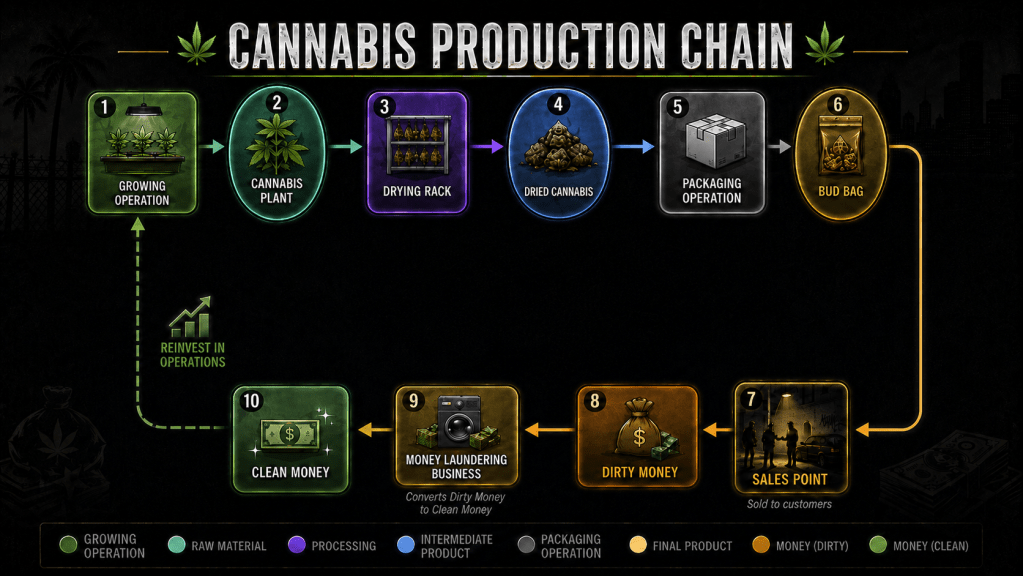
Cannabis begins at a Growing Operation, which produces the Cannabis Plant as a raw material.
That raw material is moved to a Drying Rack, where it becomes Dried Cannabis — an intermediate product. From there, it moves to a Packaging Operation, which turns it into a Bud Bag ready for distribution.
Once the final product reaches a Sales Point, it can be sold to customers and begins generating Dirty Money.
But making the sale is only part of the process.
Dirty Money can then be moved through a Money Laundering Business, converting it into Clean Money that can be reinvested into the player’s organization.
Together, these systems are helping define the kind of economy we want for Project Kingpin: one where success comes not just from controlling territory, but from building the production, infrastructure, logistics, and money flow that keep a criminal organization alive.
Building the Machine
Production doesn’t happen in isolation.
Goods and money need to move between locations across the player’s network, making logistics and the physical layout of an operation an important part of the larger economy.
A successful criminal empire isn’t simply a collection of businesses scattered around the city. The individual pieces need to work together.
Where you produce something, where it is processed, where it is packaged, where it is sold, and where the resulting money goes all become parts of the same interconnected system.
This is where the management sim side of Project Kingpin starts to become especially important. As the player’s organization grows, so does the machine they are responsible for managing.
And cannabis is only one part of it.
We’ve also been developing a second Production Chain that gives players another way to build out their criminal economy — but we’ll keep that one secret for now 🙂
Finding the Look of the Game
On the art side, July focused less on expanding the city itself and more on answering an important question:
What should playing Project Kingpin actually look and feel like?
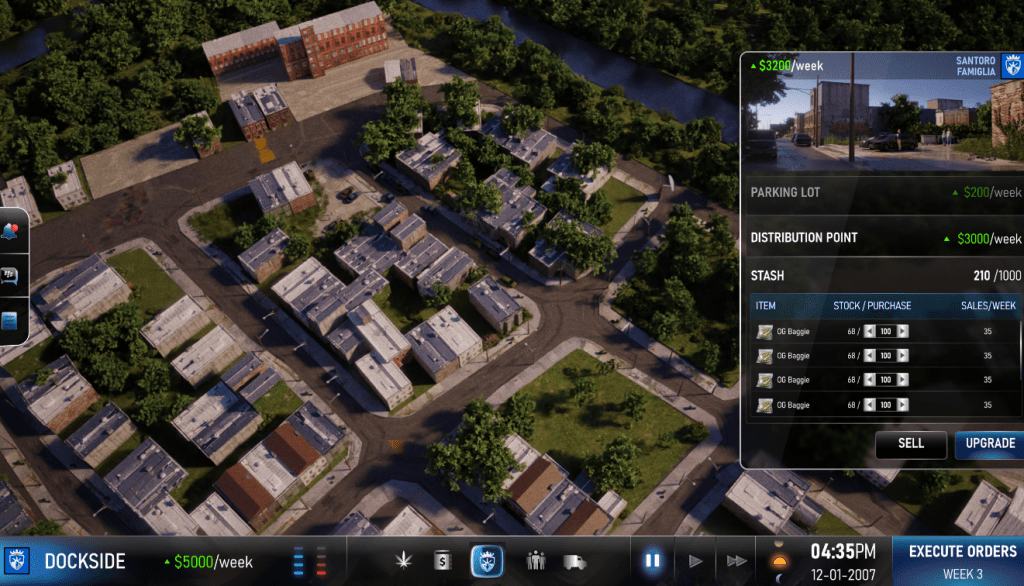
We began exploring the art direction for the game’s interface, experimenting with visual ideas inspired by the technology, graphic design, and digital interfaces of the early 2000s.
One direction we’ve been exploring draws inspiration from the BlackBerry era — combining the utilitarian feeling of early mobile technology with the information-heavy needs of a strategy game.
It’s an interesting challenge.
The interface needs enough personality to help ground the game in its time period, but it also has to communicate a large amount of information about characters, crews, businesses, gangs, police, territory, orders, and the city itself.
Clarity always has to come first.
The goal isn’t simply to make the UI look like something from the early 2000s. It’s to take inspiration from that era and build a visual language that feels distinct to Project Kingpin while still being intuitive to use in a modern strategy and management game.
Here’s a work-in-progress screenshot showing the direction in action.
Note: These are not final visuals.
Union City is Becoming More Reactive
The biggest takeaway from July is that more of the systems surrounding the player are beginning to come online.
Rival gangs can respond to aggression.
Police are becoming an active part of the simulation.
The structure behind the criminal economy is becoming clearer.
And the interface through which players will eventually manage all of it is beginning to take shape.
Individually, each of these systems solves a different problem. Together, they start creating something much more important: a city that reacts to the organization you’re building inside it.
That remains at the center of what we’re trying to create with Project Kingpin.
Building a criminal empire shouldn’t just mean accumulating money or coloring more of the map in your faction’s color. It should mean constructing and managing an organization — crews, criminal operations, relationships, territory, intelligence, logistics, and infrastructure — inside a city filled with other groups trying to protect their own interests.
That combination of crime strategy, simulation, and organization management is at the heart of Project Kingpin !!
Join Our Community: We Want to Hear From You !
Your voice truly shapes the future of Project Kingpin. Join our Discord, vote, share your thoughts, and help us build the ultimate crime empire experience together.
Join our server below👇