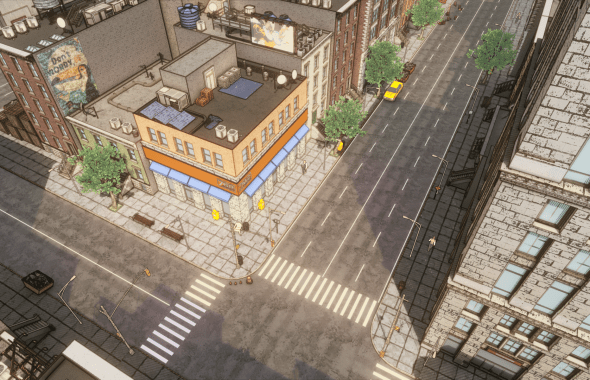
December was a “back to fundamentals” month for Project Kingpin, our debut crime strategy game.
We’ve been confident in the concept and the core fantasy for a long time, but we also got honest about a key issue: the current prototype lacked system cohesiveness and clarity. Some mechanics were strong on their own, but the relationships between systems, and the why behind player actions, weren’t consistently readable.
So we stepped back, tightened the vision, and built the design scaffolding we need to move into our next iteration with purpose, so the game becomes easier to understand, harder to master, and more satisfying to grow into.
Clarity, for us, meant acknowledging the gap between strong ideas and a readable experience. December was about closing that gap by aligning systems, intent, and fantasy into a structure the project can confidently grow from.
-Marisardo Filho
Game Designer
Game Design: From a Great Concept to a Cohesive System
In November, we shared that our focus was revisiting the core game loop from its foundations, IE making sure systems are connected, fluid, and reinforce the core fantasy of rising as an aspiring crime kingpin.
In December, we turned that intention into a concrete design framework.
Vision Guidelines Document (Our North Star)
We created a Vision Guidelines document to lock in what Project Kingpin is, what it must feel like, and how we make decisions when design gets complicated.
This isn’t a pitch deck, it’s a practical filter we’ll use to keep the game cohesive as it grows.
At the heart of the vision:
- Project Kingpin is a crime strategy sim. You’re not a lone criminal running errands, you’re building an organization: managing an economy, controlling territory, and steering relationships across a volatile underworld.
- The experience is driven by three pillars: Economy, Diplomacy, and Power, and the key is that they reinforce each other. Decisions should ripple across multiple systems, creating emergent outcomes instead of disconnected “mini-games.”
- We’re designing around three layers of control:
- Strategic = citywide planning, leverage, economic control
- Tactical = squads, operations, short-term pressure decisions
- Operational = minimized, automated, optional, or abstracted
- Our philosophy is utilize more autonomous systems: systems should run with smart defaults, and the player should set intent, not procedures, IE low friction, high impact.
- We treat scalability as a requirement: as your empire grows, your workload shouldn’t scale exponentially. You should feel more capable over time, not buried in micromanagement.
This document is now our design “North Star.” If something doesn’t reinforce the kingpin fantasy, or adds friction that doesn’t earn its complexity, it doesn’t make it into V2.
Systems Relationship Map
Once the vision was nailed down, we built a systems relationship map to visualize how everything overlaps at a high level.
The goal is to catch design problems early:
- Where systems don’t connect enough (missing links)
- Where systems overlap too much (redundancy)
- Where a core pillar isn’t being supported properly (lack of depth or definition)
This is how we ensure the game feels like one cohesive machine, not a bundle of separate features.
Systems Flowchart (Turning Relationships into Player Experience)
Then we translated those overlaps into a systems flowchart, a high-level view of our crime strategy experience.
It helps us answer questions like:
- How many systems do we have? Where are the subsystems? Is everything connected in a way that reinforces the Vision Guideline Doc?
- What does the player do, in what order, and why?
- What information do they need to make strategic choices?
- What creates pressure (risk, rivals, heat), and what provides solutions (laundering, leverage, logistics, squads)?
- Where are potential bottlenecks or confusion points?

In short: it’s the blueprint for making the loop feel clear, connected, and satisfying.
Where We Are Now
With those foundations complete, we’ve moved into a prototype audit phase:
- Comparing the current build against the V2 concept
- Identifying what needs to be redesigned, rebuilt, or cut
- Planning the changes required to get the project moving in the right direction
This work isn’t flashy but it’s what turns a promising prototype into a cohesive strategy experience.
This has been quite an adventure for us so far…from early startup obstacles, to learning who we are as a team, to tightening our pipeline and production habits. It hasn’t been easy, and there’s been no shortage of challenges.
But we’ve met them head-on, and we’re coming out stronger for it. Right now, the project feels stable. We understand the core fantasy better than ever, and we’re ready to iterate and make meaningful improvements for our community ! I cannot tell you how excited I am to share more progress updates soon.
-Matt Raimondo
Founder & CEO
Engineering: Stabilizing the Build for What Comes Next
In parallel, the engineering team focused on strengthening the foundation behind the prototype—so we can move faster, break less, and iterate with confidence as V2 changes roll in.
Before making any big changes, we wanted to clear out the technical debt… It’s like preparing the soil: once the ground is healthy and stable, new ideas can grow freely and strong.”
–Alan Brandi
Developer
Refactoring isn’t just cleanup—it’s a product decision that keeps the project stable as new systems introduce new demands.
Refactoring is a product investment as much as an engineering one. It allows us to look back and identify improvements that were previously non-critical but become essential as the product evolves and new features introduce new requirements. By reducing technical debt and reinforcing a solid architectural foundation, we intentionally step back when needed to adapt the system’s foundations, ensuring long-term stability, scalability, and the ability to ship features faster and with more confidence in the future.”
-Kaio Trindade
Developer
What’s Next?
Next, you’ll see us shift from foundation building into execution:
- Converting the V2 concept into concrete prototype changes
- Improving clarity and cohesion across the pillars
- Strengthening the strategic layer so decisions feel readable and meaningful
- Sharing more V2 direction as it solidifies
We aim to take every step in our development process with intention and clarity. Defining our milestones is essential to keep the team aligned and turn our prototype into something testable as quickly as possible.
We’re excited to share our ideas and concepts with the world, but we truly believe in the power of listening to the community to guide us in the right direction. Every piece of feedback we receive at this stage has the potential to shape the future of Project Kingpin, and that’s exactly what makes this phase so exciting !
-Breno Rodrigues
Producer
Join Our Community: We Want to Hear From You !
Your voice truly shapes the future of Project Kingpin. Join our Discord, vote, share your thoughts, and help us build the ultimate crime empire experience together.
Join our server below👇